Showing posts with label society. Show all posts

Saturday, October 6, 2012

Belonging

We all feel the almost unbearable urge to fit in somehow, to pull together the fringes of the world into place around us in the shape of family, friends, job, entertainment, clothing. We also have a sense that this is a symptom of the herd mentality and to be scorned, a shame which causes us to apply and reject the labels so frequently used: hipster, ghetto, nerd. But it is a universal necessity to belong. We seek esteem of whatever qualities in us we deem estimable--a hair cut, our ability with computers, holiness like a patched and shredded garment. Who we are often cannot stand alone. And I'm not sure it should. Fellowship is the basic emotional/spiritual need, the cry that goes deeper than Maslow's hierarchy.

See how we shift the upholstery of our souls? How this one assumes the skinny jean/shipster look and that one the pencil skirt/intelligentsia look--changing the upholstery, and sometimes the attitudes, that cover the still-beating heart and blood.

So in this sense we are shallow creatures, changeable, malleable. Ready to give up one skin for another, assuming actions, mannerisms, thought patterns like chameleons. But in another way we are sublime for this trait, for we recognize the trappings which seem to us admirable and pursue them, and our souls achieve a momentary apotheosis. It will not last, but the transformation has made us divine for a moment. It has also brought us one step closer to other souls--we have reached out of the forsaken splendor of our own souls and into the territory of another spirit.

Fellowship. The urge to belong. Part of the human condition, the splendor and the squalor.

Friday, March 30, 2012

Honesty

exhaustion--the other side of motherhood
It's hard to be honest sometimes--certainly with others but mostly with myself. Growing up one thing that was never tolerated was any kind of untruth, and I have always prided myself on my honesty. But as I grow older I'm learning that honesty isn't quite so easy to quantify, that there are many layers in a human heart and mind, and that just figuring out what's happening within--much less admitting it--can be excruciating and at times impossible.

The important thing to realize is that without honesty no relationship will flourish--it may appear to, but it is growth without foundation, foliage without roots. Whether it is friendship, romance, or collaboration, honesty must suffuse the relationship.

Honesty of thought, acknowledging truthfully to myself what I'm actually thinking, admitting and allowing myself to feel rage, frustration, love, appreciation, fear, confusion. Honesty of action, within the bounds of courtesy letting my movements speak truly of my inner state, without resorting to the hidden games of banging doors, manipulating, crowding, or clinging. Honesty of speech, actually saying what I mean without letting it build until it explodes the doors of my soul and decimates others, communicating as much as possible exactly what I think and not trying to couch the words in roundabout phrases that might shelter me from conflict.

I must acknowledge that while I see the importance of honesty, I often don't know how to live it.

What do you think about honesty? 

Monday, March 26, 2012

What I Wish I'd Known As a Teenager

Teen Week 2012 is a blog project hosted by body image warrior Medicinal Marzipan. Bloggers from around the world will be posting on topics related to self-esteem in teenage-hood. I'm honored to participate.


Growing up in a very conservative setting as I did, clothes were a big problem for me as a teenager. It was the late 90's, and I desperately wanted to fit in. All around me I saw stylish girls wearing tight pants, form-fitting tops, earrings, makeup, and elaborate nails. That was outside, 'in the world'. Closer to home were long loose skirts, loose tops, long hair, no makeup, and very little jewelry. These two images clashed horribly within me. The first was labeled "pretty" and "popular" in my mind and the second "holy" and "right".

What makes me sad now is that I never looked within for direction--and this wasn't only in the area of fashion. I was caught between a couple of boxes in the 'what-do-you-want-to-be-when-you-grow-up' department as well. It was either 'have a career' or 'be a mom'. Neither of which appealed to me all that much, to be frank. But somehow it never occurred to me that I was unique. I had a unique style, a unique perspective, and a unique destiny. No one could tell me who I was--only I could find myself.

And so this is what I say to teenaged girls everywhere: Figure yourselves out. Don't be afraid to try different clothes on, and different accents. Read books and learn what other people outside your world are doing. Go to thrift stores or learn to sew your own clothes. Learn new hobbies, make new friends. And don't be ashamed to be different from those around you. It may cause pain--you may be rejected, you may make faux-pas, you may become horribly embarrassed. But if you can be yourself, imperfect and lovely, you will find that freedom grows around you. You'll be too big to be boxed in by a movement or a fad. You can't be labeled, you can't be ignored.

For those of us who left the teen years behind years ago, I say the same. We can only be ourselves--let's be the best we can be.

Wednesday, March 7, 2012

Cabin Fever

I'm not much of a homebody, so the past month indoors as a new mother has been rather a challenge to my emotional stability! I love our two-bedroom townhouse; it's filled with momentos of good times and gifts from loved ones, its walls are painted restful and eye-delighting colors by my talented and hardworking mother, and already we have found the home in our hearts reflected in it. I love my charming daughter, with whom I spend my days. I love my writing, Netflix, cooking (and eating), endless episodes of Deep Space Nine, lots of coffee, books, occasional cleaning, and long phone calls. But I can tell you with certainty that it's not enough for my eyes to rest upon.

I need the sky--preferably crisp and blue, with white clouds drifting across like puffy cotton balls. I need the sun to kiss my face and blind me in its radiance. I need to breathe air untainted by a furnace, full of sounds and scents which have nothing whatsoever to do with me. I need to see people in their cars like beetles on the highway, to exchange pleasantries with a friendly barista, to pace the aisles of the grocery store. I need to come home tired and ready to retreat into familiar things.

I'm realizing how much I need bigness around me. I need there to be more than myself and my surroundings. Perhaps this necessity is an integral part of human nature--why, after all, we have as an entire society never been content to imagine that life ended with our bodily death. Nor have we accepted the lack of a Beyond. We need to be small in the vastness of the universe. We need to be less than something--for that means we always have something greater to which to aspire.

My cabin fever is not just due to my extroverted nature, but also to the human necessity to acknowledge myself as part of a greater whole.

Do you get cabin fever? How do you seek to remedy it?

Wednesday, February 15, 2012

Parental Ferocity

bathtime
I've always perceived myself as a rather laid-back person. Traffic doesn't bother me much, I like experimenting with food, and I'm not a neatnik. While I like being on time, I'm not obsessed with deadlines, and I try to let the people around me be themselves without pressure.

Laying aside the fact that this self-perception may just be erroneous, no one could be more surprised than I at the tide of parental ferocity which has arisen in me since my daughter was born!

Her first bath was administered by a nurse who had been working in pediatrics since the 70's and had a suitably casual approach. As my daughter squirmed and moaned under the warmer, this woman scrubbed mercilessly at the buildup of birth, informed us that babies don't like their backs touched and proceeded to rub our baby's, and actually combed my baby's hair into a kewpie curl! Though dazed from birth and unable to stand long enough to get dressed, I considered leaping from my bed and throttling the woman. (I must add that my opinion of her modulated to complete gratefulness as she proved herself remarkably thoughtful to all of us over the course of the day... some angels come in abrasive packages.)

We've endeavored to keep our little girl sequestered from the germs of the world for the past two weeks in what now seems a doomed attempt to let her immune system begin its work without interference. Only the grandparents have had the privilege of holding her small bulk, kissing her perfect face, and laughing over the impossible facial expressions with which she gifts the world.

Finally allowing some treasured family to come to visit yesterday, we ascertained that everyone was health, had been healthy, and showed no signs of declining health. The visit was wonderful.

And last night they all came down with the flu.

Turns out they had spent some time over the weekend with some friends who had been battling the stomach bug, and these friends neglected to mention that fact.

May I say, I'm livid? We won't know for a few days if our two-week-old infant will succumb to the germs, so while we live in suspense let me attempt to govern my heart into some semblance of forgiveness. The tide of bitterness rising within me as I realize that my child's health has been compromised threatens to overcome me. I want to make a furious phone call, I want to publish the ignominy from the rooftops.

Why does this so enrage me? I think it's simple: my daughter's physical and emotional well-being are my husband's and my responsibility right now. We are the gatekeepers. And our gates have been breached.

I ruefully acknowledge that I cannot protect little E. from everything in the world. I can't guarantee that she'll never be sick, that she'll never have her heart disregarded, that she'll never make a mistake. I am fallible. As a passionate parent I have limitations. I am not omniscient nor am I all-powerful.

But I will do my best to protect her, and when my protection fails I will comfort her. And I will not hesitate to speak in her defense until she can speak for herself. The parental ferocity which has so suddenly arisen within me has a purpose!

What about you? If you're a parent, do you find yourself feeling the same way? If not, what do you think about parental ferocity?

Tuesday, January 10, 2012

The Law of Club and Fang

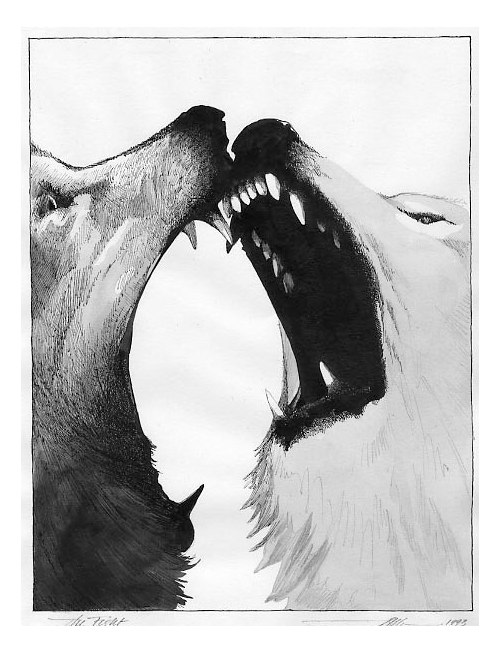
"The Fight", Barry Moser, illustrating The Call of the Wild
It's been years since I read The Call of the Wild, by Jack London. It held my interest now just as it did when I was twelve--who would not strain to follow the sad and descending path of that noble dog, Buck? I still gasped in horror when he was beaten by the man in the red sweater, still exalted when John Thornton saved his life, and still thrilled when he broke out and pulled for one hundred yards a sled with one thousand pounds of flour.

The impression that had remained with me was that of blood, of strife, of howling. And this time around it was confirmed. London, largely self-educated and a firm believer in the Darwinian gospel, traces Buck's progress as he loses the sheen of civilization applied by his birth in the warm Southland and connects with the atavistic power of his forebears. The book could hardly be called anything but The Call of the Wild, because in relentless, tight prose, London drives Buck toward answering that call. Buck quickly learns that mercy is seen as a form of fear, that if one loses one's footing the horde will devour one, and that man with a club is a god to be feared.

In the rough and brutal world of the Alaskan gold rush, men and dogs alike face physical and emotional challenges inconceivable to many on the Outside. Those who survive will be those who learn the laws that govern them and respect the great crashing forces of nature.

Our lives bear little resemblance to theirs, but that is perhaps part of the interest we have in reading this type of book. We cannot know whether the call of the wild would draw us or our dogs, because we've never gotten quite close enough to hear it. Through Jack London's ruthless prose, we can.

Have you contemplated the Law of Club and Fang? Any thoughts on The Call of the Wild?

Tuesday, December 13, 2011

On Invasion and Public Perception

There's something about being pregnant that seems to announce to the world, "Touch me! Flatter/insult me! Tell me horror stories about the great ordeal through which I'll be going in just a few short weeks!" "Ask me hideously embarrassing questions about any topic which strikes your interest!"

Why? Why do old women and young place their hands reverently on my bump (and I'm always perversely glad when my child refuses to move until they're gone)? Why does my weight--always before a subject not to be ventured upon--become of such interest and approval/disapproval? And why in the name of all that's holy does every woman who has ever given birth, thought of giving birth, or heard of someone else giving birth tell me about all that can go wrong with birth--the enforced C-section, the endless labor with no progress, the hospital that ignored everything it was told--and then blithely turn away from me, saying, "Good luck with yours!"? Why do people ask me how we conceived this child (and yes, I'm tempted to say, "The usual way")?

I seem to remember reading a discussion at some point about how the pregnant woman becomes public property--how most individuals in our culture seem fascinated by the burgeoning belly, by the promise of new life, by the straying from the perceived societal norm of flat bellies. It is as if personal boundaries--easily infringed upon in daily life--become non-existent during the five or so months when pregnancy is discernable.

This may be partly due to the fact that, due to the obvious nature of pregnancy, one's personal life becomes suddenly public. The state of my reproductive organs has always been of an intensely personal nature to me, but now anyone,--from the waiter who offers my husband and myself seating for "Two and a half" to the smiling strangers who ask me when I'm due--can see exactly what is happening in the innermost sanctum of my body and make a crushingly good guess about what is happening in my emotional temple as well. My womanhood, which before I could either downplay or accentuate by my wardrobe choices and carriage, is now flaunted before the world. Every move I make fairly displays the femininity I carry. My round and lovely belly going before me is the flag of identification with every mother throughout history who has populated the world with all these wonderful, zany, tactless people.

It's a strange, far-too-public place to be. And yet there is very little I can do about it other than the obvious: repel unwanted advances, though that becomes very difficult as I'm usually not prepared and often in the moment more concerned about giving offense than anything else.

Am I the only one who feels this way? Am I missing a vital point in this public interaction during pregnancy? What is the strangest position in which you've been placed by being pregnant in public? I look forward to hearing your thoughts.

Tuesday, November 8, 2011

On Scarcity


I finished One Day in the Life of Ivan Denisovich this morning. I've read it in bits and pieces over the last month and have found myself captivated by the moment-by-moment optimism of Shukhov, an innocent man sentenced to ten years in a Russian hard-labor camp, by the dominance of individuality even in an environment specifically designed to strip all vestiges of personality from each prisoner, and by the kind of courage that can leave behind what should have been and what could have been for what is.

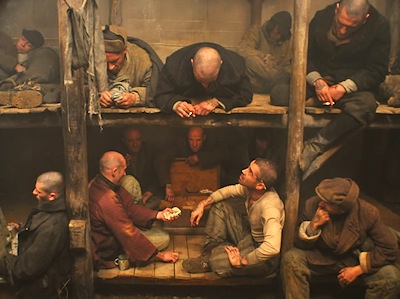
Life in the Soviet Gulag
If you own this picture, please contact me!

For those unfamiliar, the book follows Ivan Denisovich Shukhov, prisoner C 854, through one day in an unnamed labor camp. A great portion of Shukhov's energy is expended in obtaining food--whether through guile or through favors for others. He wastes little energy, after eight years of his sentence, on thinking about his wife and children in a countryside kolkhoz, or collective farm, nor does he bother himself with questions of right or wrong, with prayer--other than a brief thankful acknowledgement to God for the small blessings of the day--with musings on mortality, or with friendship among his fellow zeks. He loves his work, becoming so entranced with building a wall that he nearly misses the prisoner count and causes his entire squad to be punished. Among the many players within his world, he knows his place and keeps it, rendering respect to those above him and disdain to those below. There are members of the intelligentia imprisoned with him yet he displays no interest in their learned conversation, betraying Solzhenitsyn's own attitude toward the intellectual elite--ironic, since men and women who viewed the world as Shukhov did were very unlikely to read or approve of One Day but it became the banner work of Soviet liberals and intellectuals alike.

Alexander Solzhenitsyn
Sozhenitsyn
Credit: AP Photo/Jacques Brinon
Solzhenitsyn was born at the peak of the Civil War in 1918, the same year the last Tzar and his family were executed, and served Mother Russia as a battery commander in WWII. After years of  keeping his mouth shut, he made the mistake of writing disparagingly of Stalin in a series of letters to a friend, who turned him in to the authorities and landed him in various concentration and labor camps for eight years. (1945-53)

Here's what I find the most telling sign of the political oppressions of the time: publication of One Day in 1962 marked the first mention in print of the forced labor camps  in Russia! Solzhenitsyn won the Nobel Prize for literature in 1970, "for the ethical force with which he pursued the indispensible tradition of Russian literature", an event which caused him to be exiled from the Soviet Union.

He coined the now-predominant term "GULAG" for the Soviet system of forced labor which began under Stalin after WWI and did not fully end until Gorbachev's time. Numbers vary, but it is believed that over a million persons lived and died in these camps.

Growing up in the conservative Christian tradition, I often pondered whether I would stand firm for my faith under the threat of torture or martyrdom. I find the same self-searching mood is born from reading One Day in the Life of Ivan Denisovitch and that I am unsure how I would act were I to find myself in a similar situation to the protagonist. If bread were scarce, would I share my only crust with my husband, my child? I like to think I would. But we don't know, living as we do in the fullness of Western plenty, how our essential selves would crumble under a cruel regime.

I am thankful I do not have to face these trials today, and hope for fortitude should I do so one day. Scarcity of anything is a fearsome thing.