Showing posts with label literature. Show all posts

Monday, April 9, 2012

Book Review... The Somnambulist

image source
This book is written with a delightful vocabulary and a marvelous appreciation of prose. Each sentence seems crafted with care and is a joy to read. In Jonathan Barnes's debut novel, the Victorian detective story is brought to a beautiful stylistic level. 


That said, I found that several aspects of the book did not deliver as promised. The style was self-conscious, the point of view occasionally shifting without reason, and the unreliable narrator--when revealed--unlikeable and rather uninteresting. In addition, there is much to-do about the wickedness in the book, but the overall impression is just muddiness, the complete plot is exceptionally thin, and the title character, The Somnambulist, has not even a crucial role in the plot. Nothing more is known about him at the end than the beginning. There are hints that he is the soul of London, slumbering beneath to rise again when salvation is needed, but the reader is left confused as to why--other than for a snappy title--the book is called The Somnambulist.


Edward Moon, a fading magician, is introduced as the protagonist, but there is little about him to care for or even to revile. In fact, the most loveable/interesting of the characters is the grotesquely fat Fiend, whose origins are only barely hinted at. There is much left unwritten in this book, which leaves the plot shallow and unwieldy. It takes a wild turn into the absurd partway through which, I'm sad to say, ruined my suspension of disbelief and had me raising my eyebrows in displeasure.


In spite of these flaws, Jonathan Barnes shows great promise in his first novel. I will continue to read his upcoming works, in hopes that the scintillating style will be matched by just as cunning a plot and just as consistent the characters, next time around.

Tuesday, January 10, 2012

The Law of Club and Fang

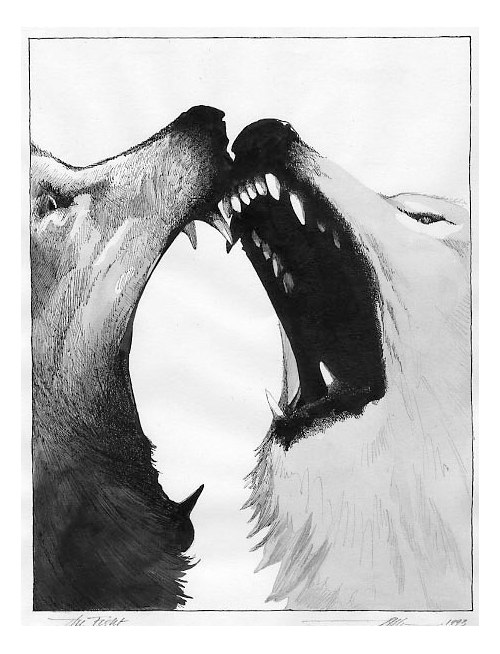
"The Fight", Barry Moser, illustrating The Call of the Wild
It's been years since I read The Call of the Wild, by Jack London. It held my interest now just as it did when I was twelve--who would not strain to follow the sad and descending path of that noble dog, Buck? I still gasped in horror when he was beaten by the man in the red sweater, still exalted when John Thornton saved his life, and still thrilled when he broke out and pulled for one hundred yards a sled with one thousand pounds of flour.

The impression that had remained with me was that of blood, of strife, of howling. And this time around it was confirmed. London, largely self-educated and a firm believer in the Darwinian gospel, traces Buck's progress as he loses the sheen of civilization applied by his birth in the warm Southland and connects with the atavistic power of his forebears. The book could hardly be called anything but The Call of the Wild, because in relentless, tight prose, London drives Buck toward answering that call. Buck quickly learns that mercy is seen as a form of fear, that if one loses one's footing the horde will devour one, and that man with a club is a god to be feared.

In the rough and brutal world of the Alaskan gold rush, men and dogs alike face physical and emotional challenges inconceivable to many on the Outside. Those who survive will be those who learn the laws that govern them and respect the great crashing forces of nature.

Our lives bear little resemblance to theirs, but that is perhaps part of the interest we have in reading this type of book. We cannot know whether the call of the wild would draw us or our dogs, because we've never gotten quite close enough to hear it. Through Jack London's ruthless prose, we can.

Have you contemplated the Law of Club and Fang? Any thoughts on The Call of the Wild?

Monday, December 5, 2011

Like Wine Through Water

 "I've dreamt in my life dreams that have stayed with me ever after, and changed my ideas; they've gone through and through me, like wine through water, and altered the colour of my mind." --Catherine Earnshaw

So much has been written about Wuthering Heights that I could add little to the cultural dialogue which has been taking place ever since the book appeared in 1847 under the androgynous psuedonym Ellis Bell, creating little stir except to be characterized as coarse, with a "moral taint", 1 offering "shocking pictures of the worst forms of humanity." Readers were advised to "burn Wuthering Heights", 2 though there were glimpses of the coming recognition, as when a reviewer said that the work "of Ellis Bell is only a promise, but it is a colossal one." 3 Critics and audience alike seemed perplexed--Victorian sensibilities were shocked, but the genius of the author was undeniable. One reviewer expressed this in writing, "Wuthering Heights is a strange sort of book,—baffling all regular criticism; yet, it is impossible to begin and not finish it; and quite as impossible to lay it aside afterwards and say nothing about it. " 4  

The book opens with the ambivalent narrative of Lockwood, the new tenant of Thrushcross Grange. Heathcliff--whose glowering brow has cast shadows and thrills through countless susceptible rebels for over 150 years through book, drama, television, and music--is introduced and the strangely-assorted house of Wuthering Heights described. And then the story unfolds. When Lockwood falls ill, his highly voluble housekeeper begins to tell the story of the Earnshaws and Lintons with all their loves and hates and intermarryings. Lockwood stays divorced from these wild dwellers of the moors, leaving the frame story quite distinct from the central narrative, returning at the end in time to witness the only happy turn of events in the story (young Cathy and Hareton Earnshaw walking through the moors together, happy with a happiness their unfortunate parents never experienced) and leaves without being detected by any other than old Ellen Dean, the housekeeper.

Heathcliff. The name summons up images of immense cruelty and romantic torture, the dark-browed Bryonic hero in all his agonies wreaking havoc unapologetically on those around him. The rags-to-riches story is universal, as is the idea of the hero found in obscurity and raised to wealth and prosperity by a benevolent sponsor, eventually falling in love with said sponsor's daughter and restoring honor and wealth to the ancestral home. Interestingly, each of these conventions is inverted in Wuthering Heights, for Heathcliff--though initially seeming favored by the master of the house--falls out of favor in a drastic way with his successor and, upon falling in love with the daughter of the house and overhearing part of her conversation condemning his place in life, leaves the Yorkshire moors for parts unknown. He returns only when he has earned enough wealth and learning to thoroughly undermine the house of Earnshaw and, it is obvious that he hopes, to win the hand of the lovely Catherine.

But Catherine--the sprite of the wilds, capricious, willful, beautiful, sympathetic and cruel by turns--has married the foppish neighbor, Edgar Linton, and here is where the story, which has heretofore been painted in tones of sepia and burnt match ends, turns to sullen charcoal and ashes. For Heathcliff is not the man to yield to fate, nor has he the resources within himself to find joy in anything at all without Catherine at his side. His obsessive love for Catherine expresses itself as a kind of creeping hate which reaches out and encompasses nearly every person on the moors who has ever touched his life. He embroils the master of Wuthering Heights in gambling debts until he owns the mansion and the man (Catherine's older brother) kills himself in drunken despair, he perverts the affections of young Hareton Earnshaw, the son of the slain man, taking great pleasure in seeing a vigorous mind sinking daily into slothpits of twisted ignorance, and he marries Catherine's pale sister-in-law only to torture her until she flees with his weak-minded son to faraway environs.

The spiralling story continues as Catherine dies in childbirth, her physical sufferings only a shadow of the emotional pain caused by a fierce interview with Heathcliff. Years pass, while Heathcliff hordes his hate, until the children are old enough to be manipulated into his diabolical plans involving a forced marriage between his son and Catherine's daughter. Here, however, for the first time in the story, a ray of light shines in pearly splendor over the tortured moors. For Cathy is not only her mother's daughter, but also her father's, and she has a depth of true affection and nobility within her which begins to slowly overcome the putridity around her.
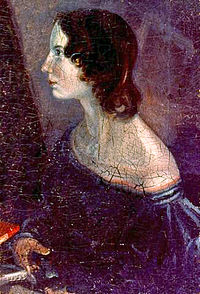
Emily Bronte
Eventually Heathcliff, tortured for twenty years by yearning for Catherine's ghost, finds it and dies happy--or at least as happy as such a twisted soul without the benefit of early love or even the slightest strain of nobility of character can, and Cathy and Hareton Earnshaw begin a new generation of lovers in Wuthering Heights, blending some of the intensity of their forebears with a purity of affection that is altogether new on these windy moors.

Much as the early reviewers did, I found myself riveted to the reading of this complex, rough-hewn book. Emily was the most private of the three Bronte sisters, and much of her personality has been obscured by the careful apology, purging, and editing done by her surviving sister, Charlotte, who was much more concerned with the opinions of the world than the others and who seemed to find the accusation of coarseness so often applied to all three sisters' work a cutting criticism. There is little remaining after Charlotte's "defense" to tell what Emily thought or felt, though she has been characterized so often as the Wild Mystic of the Moors. We have only her published work--some poems, Wuthering Heights, and a few diary pages and letters, to grant us a clue into her character.

Which leaves us solely her work to judge, not a bad situation for an author of such great stature and originality. Novels spring from their authors' minds and hearts and lives, but are not the sum or even necessarily the parts of the creator. To insinuate that Emily--to all accounts a virgin, not knowing the love of a man to her death--somehow personally experienced and embodied the characteristics of her story is to ignore the workings of creative mind and imagination combined with acute observation of humanity and nature and executed with outstanding technical prowess. Full of power, Wuthering Heights shivered me to the soul, skewering me with a kind of sympathetic horror for the individuals who so ruined their own lives and those around them. The blending of identity between Catherine and Heathcliff--embodied in her famous statement, "I am Heathcliff!" 5 --brings an underlying uneasiness to this love story and cries for repeated reading and consideration.

Have you read Wuthering Heights or seen any of the many video adaptations? What are your impressions of the story and characters?


1   Unknown. "n/a." Rev. of Wuthering Heights, by Emily Bronte. Spectator 18 December 1847: n/a. Print
2   Anonymous. "n/a." Rev. of Wuthering Heights, by Emily Bronte. Paterson's Magazine March 1848: n/a. Print
3   Anonymous. "n/a." Rev. of Wuthering Heights, by Emily Bronte. Atlas 22 January 1848: n/a. Print
4   Anonymous. "n/a." Rev. of Wuthering Heights, by Emily Bronte. Douglas Jerrold's Weekly Newspaper 15 January 1848: n/a. Print
5   Bronte, Emily. Wuthering Heights. New York: New American Library, Inc., 1959. Print. p. 84

Wednesday, November 23, 2011

Deathbed Portrait


I would like to look this peaceful when I cross the Great Divide.

I would not like to have pencil drawings made of me.

But then I'm not John Morris.

I wouldn't mind someone writing a poem.

Like this one by Dylan Thomas.

Or this one by Tennyson.
Which puts me in mind of this momento mori, commissioned by the great metaphysical poet John Donne not too long before he died.

This custom was common in his time. Donne, however, after his beloved wife Anne died, seemed to have anticipated the soft-footed arrival of Death far more than most of us! He preached on it, declaring in his last sermon that "We have a winding sheet in our mother's womb, which grows with us from our conception, and we come into the world wound up in that winding sheet, for we come to seek a grave."


Some of his most famous poetry was inspired by his fixation on death as well--the constantly quoted lines, "No man is an island/entire of itself... Therefore send not to know/ for whom the bell tolls,/It tolls for thee."


I liked him better when he was licentious.

Tuesday, November 15, 2011

The Wiley, Windy Moors


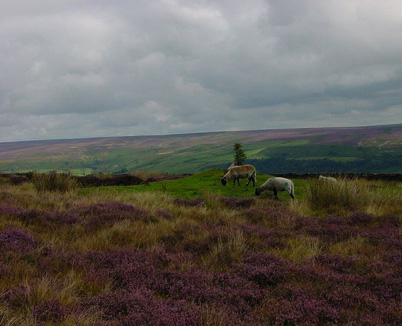
I'm preparing a longer post on my latest read, Wuthering Heights, and by way of preparation I wanted to share one of my favorite songs by a truly artistic and eccentric lady, Kate Bush. I fancy in Kate's face I can see the manic animation of Cathy's countenance in the early days, and in spite of some over-drama I am mesmerized by the weird quality of Kate's voice. She's captured the strange and lonely elegance of the Yorkshire moors as presented by Emily Bronte.

What do you think?

Tuesday, November 8, 2011

On Scarcity


I finished One Day in the Life of Ivan Denisovich this morning. I've read it in bits and pieces over the last month and have found myself captivated by the moment-by-moment optimism of Shukhov, an innocent man sentenced to ten years in a Russian hard-labor camp, by the dominance of individuality even in an environment specifically designed to strip all vestiges of personality from each prisoner, and by the kind of courage that can leave behind what should have been and what could have been for what is.

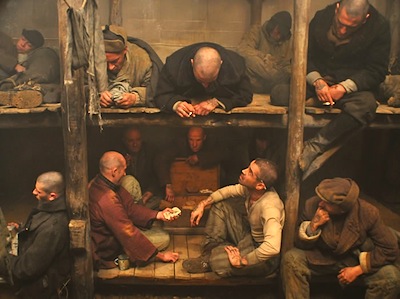
Life in the Soviet Gulag
If you own this picture, please contact me!

For those unfamiliar, the book follows Ivan Denisovich Shukhov, prisoner C 854, through one day in an unnamed labor camp. A great portion of Shukhov's energy is expended in obtaining food--whether through guile or through favors for others. He wastes little energy, after eight years of his sentence, on thinking about his wife and children in a countryside kolkhoz, or collective farm, nor does he bother himself with questions of right or wrong, with prayer--other than a brief thankful acknowledgement to God for the small blessings of the day--with musings on mortality, or with friendship among his fellow zeks. He loves his work, becoming so entranced with building a wall that he nearly misses the prisoner count and causes his entire squad to be punished. Among the many players within his world, he knows his place and keeps it, rendering respect to those above him and disdain to those below. There are members of the intelligentia imprisoned with him yet he displays no interest in their learned conversation, betraying Solzhenitsyn's own attitude toward the intellectual elite--ironic, since men and women who viewed the world as Shukhov did were very unlikely to read or approve of One Day but it became the banner work of Soviet liberals and intellectuals alike.

Alexander Solzhenitsyn
Sozhenitsyn
Credit: AP Photo/Jacques Brinon
Solzhenitsyn was born at the peak of the Civil War in 1918, the same year the last Tzar and his family were executed, and served Mother Russia as a battery commander in WWII. After years of  keeping his mouth shut, he made the mistake of writing disparagingly of Stalin in a series of letters to a friend, who turned him in to the authorities and landed him in various concentration and labor camps for eight years. (1945-53)

Here's what I find the most telling sign of the political oppressions of the time: publication of One Day in 1962 marked the first mention in print of the forced labor camps  in Russia! Solzhenitsyn won the Nobel Prize for literature in 1970, "for the ethical force with which he pursued the indispensible tradition of Russian literature", an event which caused him to be exiled from the Soviet Union.

He coined the now-predominant term "GULAG" for the Soviet system of forced labor which began under Stalin after WWI and did not fully end until Gorbachev's time. Numbers vary, but it is believed that over a million persons lived and died in these camps.

Growing up in the conservative Christian tradition, I often pondered whether I would stand firm for my faith under the threat of torture or martyrdom. I find the same self-searching mood is born from reading One Day in the Life of Ivan Denisovitch and that I am unsure how I would act were I to find myself in a similar situation to the protagonist. If bread were scarce, would I share my only crust with my husband, my child? I like to think I would. But we don't know, living as we do in the fullness of Western plenty, how our essential selves would crumble under a cruel regime.

I am thankful I do not have to face these trials today, and hope for fortitude should I do so one day. Scarcity of anything is a fearsome thing.